
![How Many Teachers Use AI in the Classroom? The Real Numbers [2026]](/_next/image?url=%2Fassets%2F13.jpg&w=3840&q=75)
AI in classrooms isn't coming. It's already here. And more teachers are bringing AI tools into their classrooms faster than anyone predicted.
The short answer? Between 60-85% of U.S. public school teachers used AI tools during the 2024-2025 school year. That's roughly 2.3 to 3.2 million teachers out of 3.8 million, and it's nearly double the rate from just two years ago. Below, we break down exactly who's using AI, what they're using it for, why it's happening so fast, and what teachers actually think about it.
How Many Teachers Use AI in the Classroom 2026?
Let's start with the numbers you came here for.
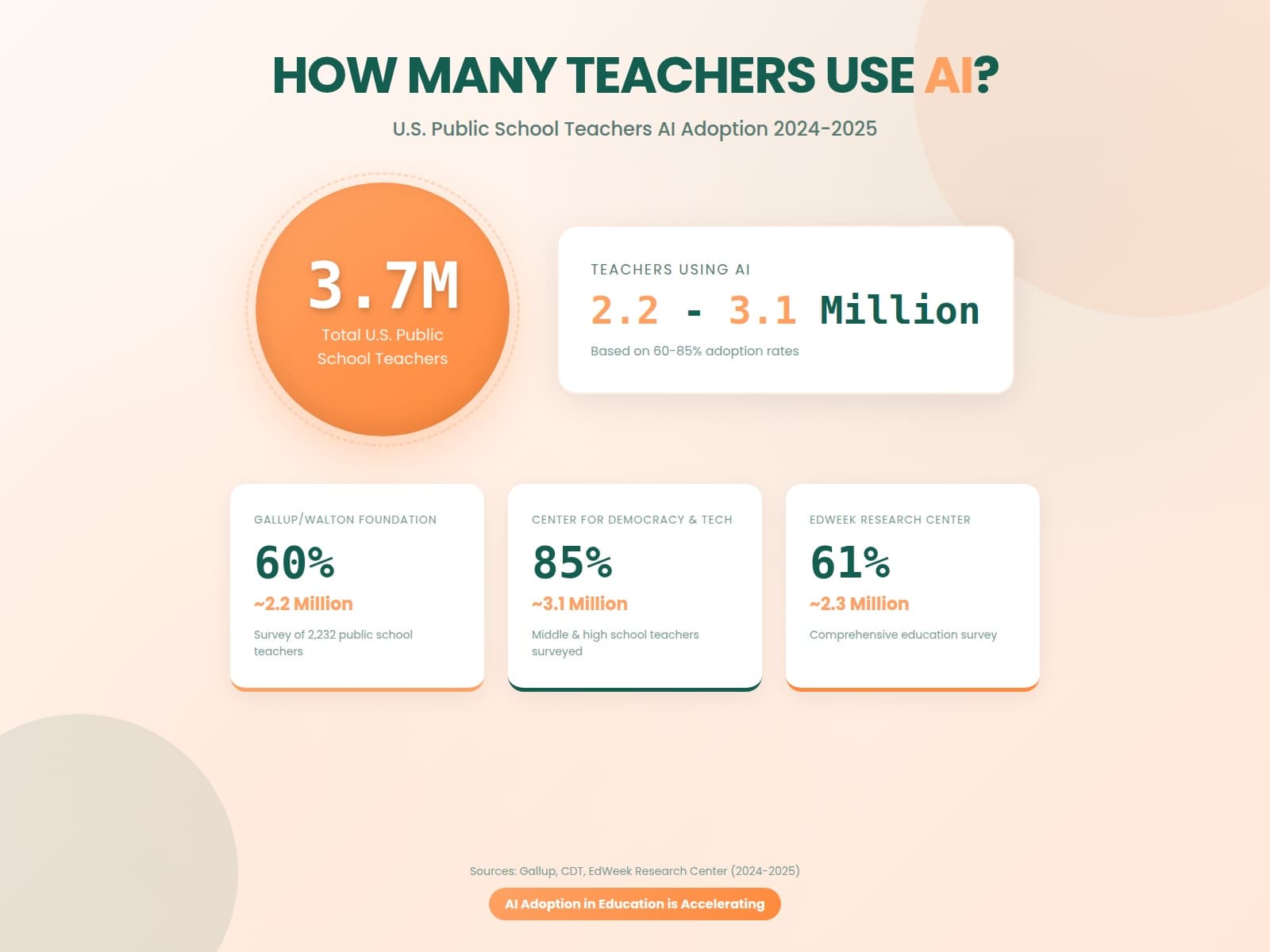
Out of approximately 3.8 million public school teachers in the United States, roughly 2.3 to 3.2 million are now using AI tools in their classrooms and work. The range depends on which survey you look at, since each defines "use" slightly differently. Here's how the three major surveys compare:
| Survey Source | Adoption Rate | Estimated Teachers Using AI |
|---|---|---|
| Gallup/Walton Family Foundation | 60% | ~2.3 million |
| Center for Democracy & Technology | 85% | ~3.2 million |
| EdWeek Research Center | 61% | ~2.3 million |
The global picture is even bigger. The OECD surveyed 280,000 teachers across 55 countries through its TALIS 2024 study and found that 36-41% use AI, meaning tens of millions of educators worldwide are now incorporating artificial intelligence into their classrooms.
Teacher Usage of AI by Grade and Location
How Many Teachers Use AI weekly?
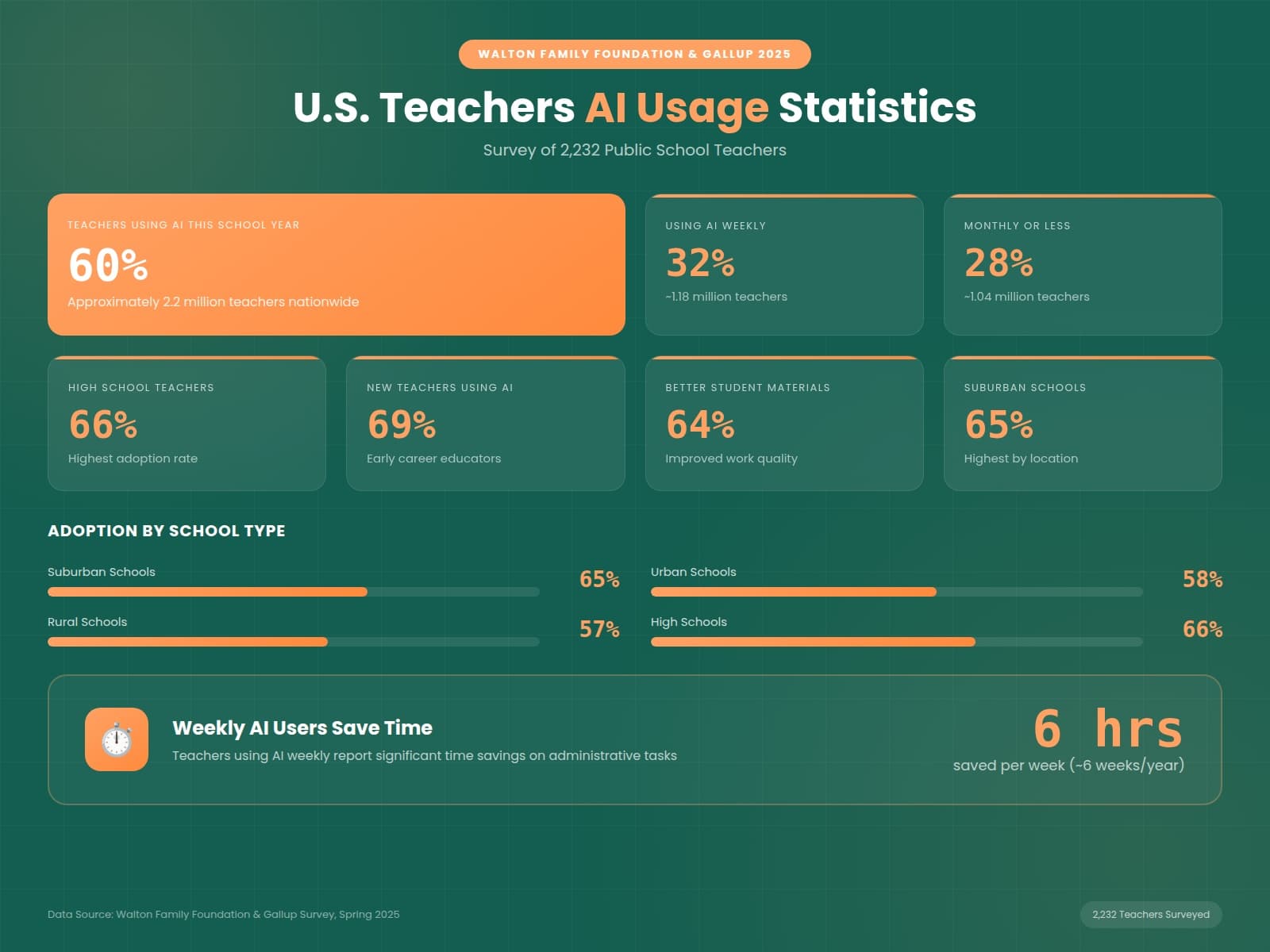
Not all AI-using teachers use it the same way. The Walton Family Foundation and Gallup study of 2,232 public school teachers reveals a sharp split:
| Usage Pattern | Percentage | Estimated Teachers (of 3.8M) |
|---|---|---|
| Used AI at all this school year | 60% | ~2.28 million |
| Using AI weekly | 32% | ~1.22 million |
| Using AI monthly or less | 28% | ~1.06 million |
The weekly users are where the real story is. These teachers save about 6 hours per week on work tasks, which adds up to roughly 6 extra weeks over a full school year. They also report that AI improves the quality of their work — about 64% said it helps them create better student materials adapted to different learning needs.
How Many Teachers Use in High School
AI adoption climbs steadily with grade level. According to RAND's 2025 research, adoption among core subject teachers broke down as follows: elementary teachers at 42%, middle school teachers higher, and high school teachers leading at 69%. The Gallup study found 66% of high school teachers and 69% of new teachers (those with fewer years of experience) used AI tools.
How Many Teachers Use AI in Urban and Suburban?
Geography matters too. Suburban school teachers lead at 65% adoption, followed by urban teachers at 58% and rural teachers at 57%. The gap isn't enormous, but it tracks closely with training access — districts with more resources tend to adopt faster.
How Many Teachers Use AI in Singapore and UAE?
Globally, the OECD's TALIS 2024 data, analyzed by Education International, shows dramatic differences:
| Country/Region | Teachers Using AI | Teachers Trained on AI |
|---|---|---|
| Singapore | 75% | 76% |
| United Arab Emirates | 75% | — |
| OECD Average | 36-41% | — |
| France | 14% | 9% |
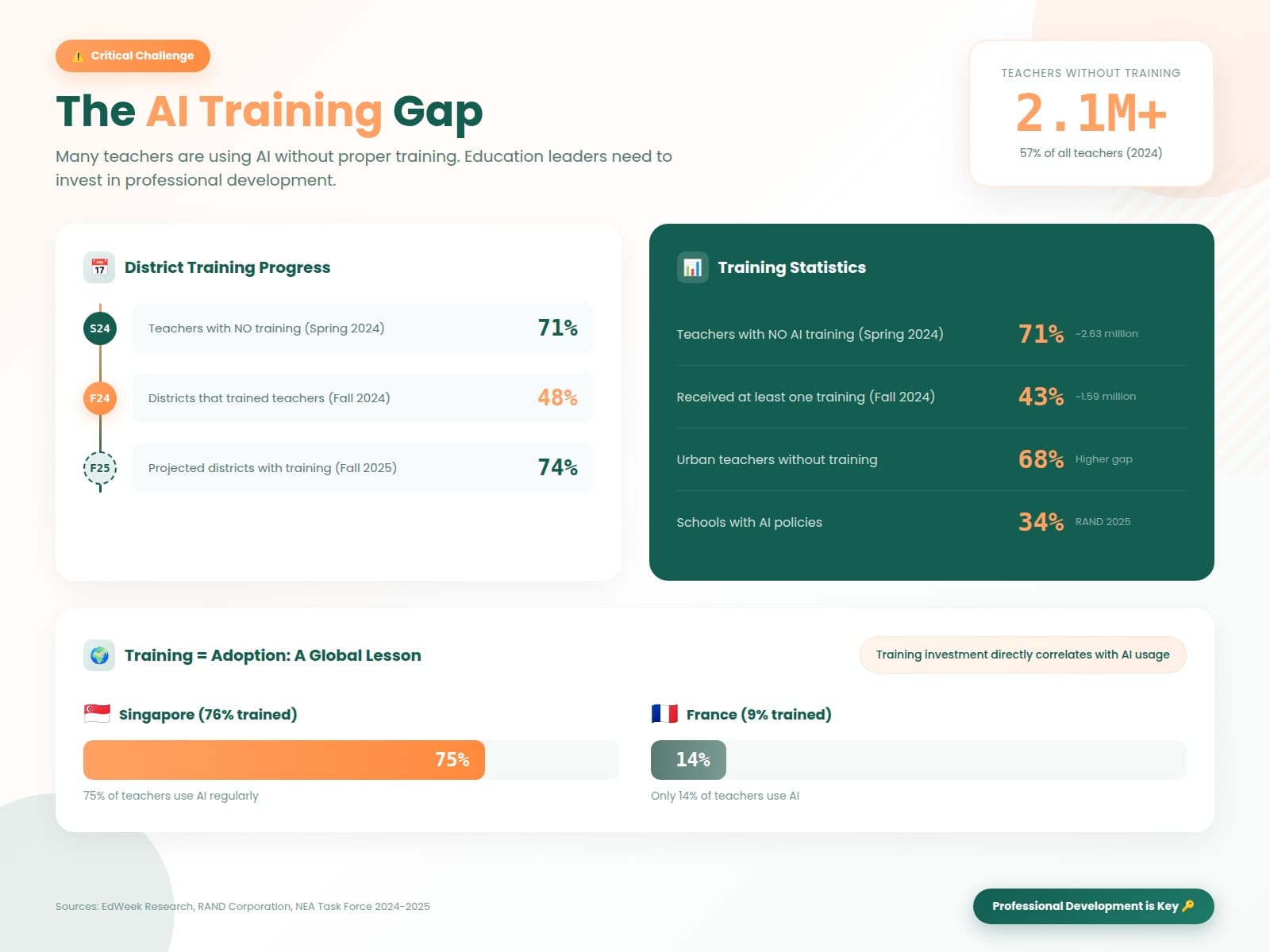
The pattern is clear: countries that invest in training get higher adoption. Singapore trained 76% of its teachers and got 75% using AI. France trained 9% and got 14% adoption. Training drives usage.
How Teachers Are Using AI in the Classroom
Top 8 AI Use Cases for Teachers
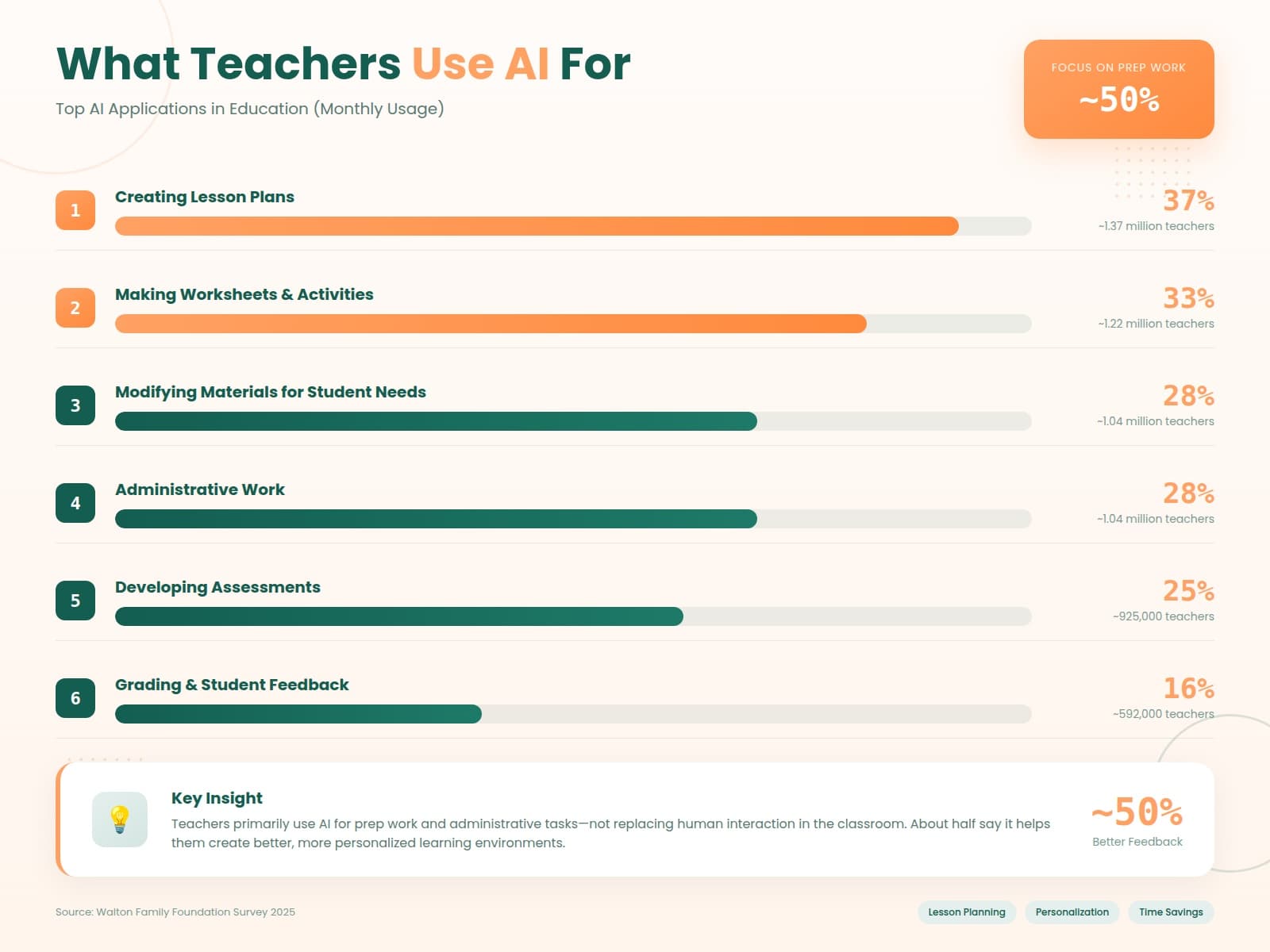
Here's how teachers use AI tools, ranked by monthly usage from the Walton Family Foundation survey:
- Creating lesson plans — 37% (~1.41 million teachers). Tools like an AI question generator help teachers quickly build question sets aligned to their lesson objectives.
- Making worksheets and activities — 33% (~1.25 million). Many educators pair AI worksheet tools with an AI flashcard generator to create both practice materials and study aids from the same source content.
- Modifying materials for different student needs — 28% (~1.06 million)
- Administrative work — 28% (~1.06 million)
- Developing assessments — 25% (~950,000). An AI test generator can produce full exams with answer keys in minutes, a task that used to take hours of manual work.
- Grading and student feedback — 16% (~608,000)
- One-on-one instruction — 14% (~532,000)
- Analyzing student data — 12% (~456,000)
Preparing class using AI improve classroom quality
The pattern is unmistakable: teachers lean on AI most for classroom preparation, not for replacing human interaction during class time. Lesson plans, worksheets, and differentiated materials top the list. Grading, tutoring, and data analysis remain less common but are growing.
That said, the classroom impact is real. The CDT survey of 806 middle and high school teachers found that 69% said AI tools have improved their teaching methods, 55% agreed AI has given them more time to interact directly with students, and 57% used generative AI to help write IEPs for students with disabilities. Teachers reported using AI for curriculum development (69%), student engagement (50%), and grading tools (45%).
And EdWeek reports that 59% of teachers say AI has enabled more personalized instruction in their classrooms, suggesting that even when AI is used for prep, the benefits flow directly into the classroom experience. For a deeper dive into how AI assessment tools stack up, see our guide to the pros and cons of AI quiz generators.
Teachers use AI to save time and improve teaching quality
It Saves Serious Time
The single biggest driver is time. Teachers who use AI weekly save about 6 hours per week on work tasks, according to the Gallup/Walton Family Foundation study. Over a 38-week school year, that adds up to roughly 6 extra weeks of recovered time. In a profession where burnout is a constant threat, those hours matter enormously. Teachers are using them to focus on what they got into teaching for in the first place: actual teaching, one-on-one time with students, and creating more engaging classroom experiences.
The Research Shows AI Can Actually Work
Teachers are also motivated by growing evidence that AI genuinely improves learning outcomes when used correctly. A Harvard University study published in June 2025 in Scientific Reports tested a custom-built AI tutor against active-learning classrooms in an introductory physics course. The results were dramatic: students using the AI tutor learned more than twice as much as those in traditional active-learning classrooms, and did it in less time. AI-tutored students also reported higher engagement (4.1/5 vs 3.6/5) and more motivation to learn.
The key was design. The AI tutor wasn't just raw ChatGPT. It was built with research-based teaching principles: giving one step at a time, encouraging students to think before revealing answers, and keeping responses brief to avoid cognitive overload. The researchers suggest using AI before class to teach foundational concepts, freeing up classroom time for deeper problem-solving and group work.
There's an important caveat: unguided use of ChatGPT for homework has been shown to hurt student achievement. The difference between AI that helps and AI that hurts comes down to how it's designed and implemented in the classroom.
Professional Development Finally Caught Up
The third driver is training. As more districts invested in AI professional development, teachers gained the confidence and practical knowledge to try AI tools themselves. EdWeek's experts point to professional development as the top factor behind the 2024-to-2025 adoption surge, noting that "as more schools and districts invest in AI training, teachers are seeing practical use cases and gaining the confidence to try these tools themselves."
AI in Classroom Adoption for Teacher
Teacher AI Adoption 2023-2025
EdWeek's surveys capture just how fast this happened:
| Year | Teachers Using AI | Estimated Number |
|---|---|---|
| 2023 | 34% | ~1.29 million |
| 2024 | 32% | ~1.22 million |
| 2025 | 61% | ~2.32 million |
That's roughly 1 million more teachers jumping in between 2024 and 2025 alone. RAND's data tells a similar story: AI use among ELA, math, and science teachers went from 25% in the 2023-2024 school year to 53% by spring 2025 — more than doubling in a single year.
Training Is Scaling. But the Equity Gap Is Real
Adoption depends on training, and training has accelerated dramatically. From EdWeek's research and RAND's district training survey:
| Training Milestone | Percentage |
|---|---|
| Teachers with NO AI training (Spring 2024) | 71% |
| Teachers with at least one training (Fall 2024) | 43% |
| Teachers with AI professional development (Spring 2025) | 55% |
| Districts that trained teachers (Fall 2024) | 48% |
| Low-poverty districts that trained teachers | 67% |
| High-poverty districts that trained teachers | 39% |
| Projected districts with trained teachers (Fall 2025) | 74% |
By spring 2025, 55% of teachers had received some AI professional development, up from 29% just a year earlier. But the equity gap is stark: low-poverty districts are nearly twice as likely to have trained teachers (67%) compared to high-poverty districts (39%). RAND projects this gap will persist even as more districts build out training programs.
The Biggest Training Push Yet: 400,000 Teachers
The largest effort to close this gap launched in March 2026. The American Federation of Teachers opened the National Academy for AI Instruction, a $23 million initiative backed by Microsoft, OpenAI, and Anthropic to train 400,000 teachers — roughly 1 in 10 U.S. teachers — on how to use AI in the classroom over five years. The first training sessions are already underway at the academy's flagship facility in Manhattan, where teachers are learning to build AI tools that go beyond basic lesson planning into more advanced instructional uses.
The NEA Task Force report has also emphasized that educators need more training to teach with AI and teach about AI. Building AI literacy among teachers remains a major challenge nationwide.
The Policy Gap: Teachers Are Ahead of Their Districts
Even as teachers adopt AI rapidly, institutional guidance hasn't kept up. Only 45% of principals reported that their school or district has policies or guidance on AI use, and just 34% of teachers said their district has policies specifically addressing academic integrity and AI, according to RAND. Most educators are figuring out AI on their own — without clear guardrails from their districts on what's appropriate and what's not.
Legislators are trying to catch up. By mid-2025, all 50 U.S. states plus Washington D.C. and U.S. territories had reviewed or proposed AI-related legislation, with some states taking aggressive action. New York, for example, banned the use of facial recognition technology in schools to protect student privacy. But translating state-level activity into clear, actionable classroom policies remains a work in progress for most districts.
Benefits of Teachers using AI
Data from the World Economic Forum, Microsoft's 2025 study, and multiple surveys paint a genuinely encouraging picture for teachers who've embraced AI:
Teachers Are More Effective
- 69% of teachers say AI has improved their teaching methods in the classroom
- 59% say AI has enabled more personalized instruction for their students
- 55% say AI has given them more time to interact directly with students
- Weekly AI users save ~6 hours per week, equivalent to 6 extra weeks per school year
- About 64% of weekly users say AI helps them create better student materials
Improve Classroom outcome and Accessibility
- 57% of teachers believe AI can improve accessibility for students with disabilities
- 65% of special education teachers are especially optimistic about improving student outcomes
- 57% of teachers in the CDT survey used generative AI to help write IEPs
Students Can Learn More Effectively
- Harvard's study found students learned more than twice as much with a well-designed AI tutor vs. active-learning classrooms
- AI-tutored students reported higher engagement and more motivation to learn
- Schools using adaptive AI learning platforms report a 12% boost in student attendance rates, suggesting AI-powered personalization keeps students more consistently engaged
- 71% of teachers (~2.70 million) believe AI will be essential for students' future success
- Teachers who use AI more frequently tend to feel more positive about its impact
Cons of Teachers using AI
For all the enthusiasm, teachers are not naive about the risks. The concerns are specific, widespread, and grounded in what they're seeing in their classrooms every day.
Lower Critical Thinking Skills
- 70% of teachers (~2.66 million) worry AI weakens important skills students need
- 57% think AI decreases independent thinking and problem solving
- 52% worry specifically about critical thinking declining
- Even Harvard's researchers warned that unguided ChatGPT use can harm student achievement by letting students bypass the thinking process entirely
Students are Less Connected to the Class and Teachers
- 54% of students now use AI for schoolwork as of spring 2025 according to RAND — meaning students are adopting AI at nearly the same rate as their teachers, often without any formal guidance on how to use it responsibly. For the full picture on student adoption, see our breakdown of how many students use AI for school.
- Over half of students say using AI in class makes them feel less connected to their teachers
- Students worry about being falsely accused of using AI to cheat
- Over 80% of students reported that teachers did not explicitly teach them how to use AI for schoolwork
Data Privacy Concerns
- 28% of teachers (~1.06 million) oppose AI in K-12 schools entirely
- 21% say they've never used AI and don't plan to start
- Data privacy, academic dishonesty, and lack of institutional guidance remain top concerns
The overarching tension is clear: teachers see AI's benefits for engagement and efficiency but are genuinely worried about kids becoming too dependent on it. Many educators want more and better training before they feel confident that these tools are doing more good than harm.
Quick Stats Recap
| Stat | Number |
|---|---|
| U.S. teachers using AI in the classroom (range) | 60-85% (~2.3 to 3.2 million) |
| Teachers using AI weekly | 32% (~1.22 million) |
| Time saved by weekly users | ~6 hours/week (~6 weeks/year) |
| Teachers who say AI improved their teaching | 69% |
| Teachers who say AI enabled personalized instruction | 59% |
| Harvard study: AI tutor vs. active-learning classroom | 2x+ learning gains |
| Teachers worried AI weakens student skills | 70% (~2.66 million) |
| Teachers with AI training (Spring 2025) | 55% (~2.09 million) |
| Global OECD average | 36-41% |
| Students using AI for schoolwork (RAND, Spring 2025) | 54% |
| Attendance boost from adaptive AI platforms | +12% |
| U.S. states that reviewed/proposed AI legislation (mid-2025) | All 50 + D.C. |
| AFT academy: teachers to be trained by 2030 | 400,000 |
The Bottom Line
Between 2.3 and 3.2 million U.S. teachers now use AI in their classrooms — that's 60-85% of the workforce, nearly double the rate from two years ago. Weekly users save about 6 hours per week, and 69% say AI has improved their teaching. Harvard research shows well-designed AI tutors can double student learning gains, but unguided use can actually hurt. The biggest challenge isn't adoption — it's equity. Low-poverty districts are nearly twice as likely to have trained their teachers as high-poverty ones. The AFT's new $23 million National Academy aims to train 400,000 teachers by 2030. The question in 2026 isn't whether teachers will use AI in the classroom. It's whether they'll get the training and policies to use it well.